

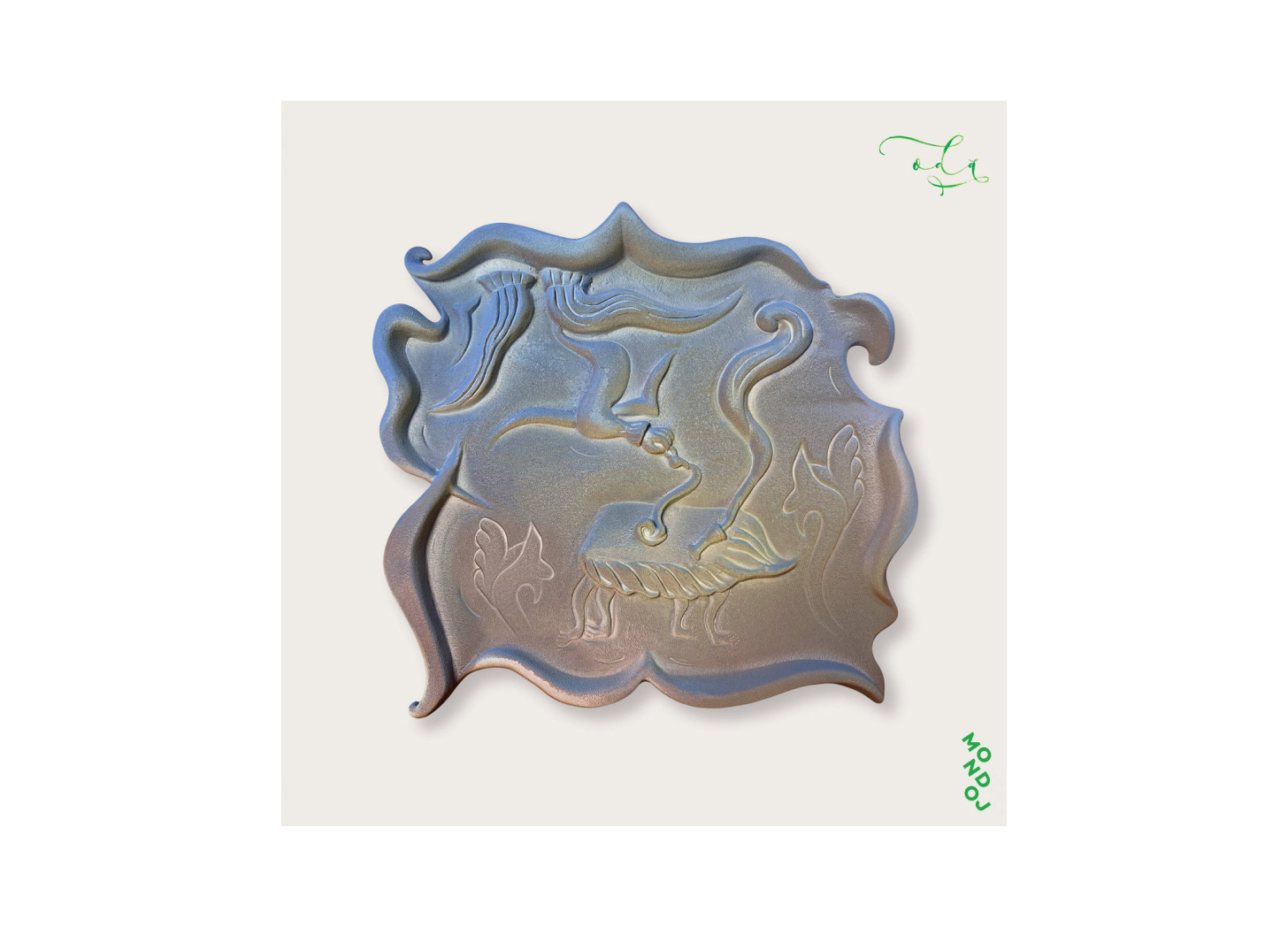
Vic Bang
Oda
Mondoj
Vic Bang doesn’t play instruments so much as she reimagines them. The Argentinian composer (real name Victoria Barca) released her debut, a set of guitar-and-drum miniatures called valses del futuro, in 2016. Since then, her approach has become more abstract, as she runs samples of real instruments through Ableton to make them markedly unreal. Barca has now dropped Oda, which feels like the culmination of her decade of experimentation. It’s an album whose sounds are both otherworldly and emotionally affecting.
Barca has a taste for small sonic details—Oda is littered with bits of sliced and diced saxophone, guitar, cello and synth—but the way those sounds combine and morph across her tracks reflects a desire to go beyond the limits of traditional composition. Melody is rarely distinct from rhythm; small snippets, expertly arranged, simply take on double duty. The clicks-and-cuts aesthetic of the early 2000s, which found music in CD skips and hardware glitches, seems like an obvious touchpoint, but Oda never actually feels like computer music. In fact, Barca cites a much different inspiration: the tuned cymbals of Balinese gamelan.
What Barca does here recalls Thomas Bonvalet’s work as L’Ocelle Mare, zeroing in on the sonic properties of instruments, particularly when they’re pushed beyond their usual use. Yet Oda is more exuberant than that, recalling the more crowd-pleasing moments of Rounds-era Four Tet. Barca also clues listeners into the source of what they’re hearing by naming most of the tracks after an instrument (or something evocative of an instrument). “Gitar,” for instance, is made with guitar, or perhaps just embodies the essence of guitar, deploying parts of notes (e.g. just the attack, or just the sustain) with a level of precision that would be impossible if one were simply playing the actual instrument. “Sopro” (Portuguese for “blow”) is about breath, which is first expressed through the voice of featured guest Camila Nebbia and then through her saxophone playing. Once again, these elements have been deconstructed to a point where they exist only as pure sound, the musical equivalent of particle vibrations. Executing that is painstaking work, and requires microscopic attention to detail, but Oda is anything but an academic listen. On the contrary, it’s warm, human and beautiful.
 |
|