

First Floor #318 – More Shackleton Please
How Shackleton's "Blood on My Hands" changed the game, plus a round-up of the latest electronic music news and a fresh bundle of recommended new releases.
I have good news and bad news.
The bad news is that today’s First Floor digest is somewhat abbreviated. (Cue all of the readers who’ve ever hit me with a TL;DR saying, “How is that bad news?”) The relative shortness is 100% my fault, as I’ve been traveling like crazy during the past few weeks; during the month of June, I went to five different places and was at home in Barcelona for a grand total of seven days. And as you read this, I’ll quite possibly still be in transit to Copenhagen, where I’ll be for two days before flying to Australia on Saturday. Is this basically the textbook definition of a first-world problem? Absolutely, but all of this moving around has completely disrupted my usual work schedule. Long story short, my inbox is out of control and I’m also way behind on listening to new music, which means I had time to contribute exactly zero write-ups to the Recommended Releases section this week.
Thankfully, First Floor now has a team of contributing writers, so five records still landed in today’s round-up. (For those curious, I’m planning to work through my backlog in the days ahead and get things back to normal by the time next week’s digest rolls around. Wish me luck.)
You’ll find those recommendations below, along with an assortment of news items, new release announcements and suggested reading links. There’s also a special guest recommendation by James Bangura, one of Washington DC’s finest production talents.
All of that hopefully sounds great, but it’s not the good news I mentioned at the very beginning of today’s mailout. The actual good news is that First Floor has been granted permission to publish an excerpt of Lauren Martin’s forthcoming new book, Aftershock: The Seismic Impact of Dubstep. That excerpt—which focuses specifically on the story of Skull Disco and Shackleton’s “Blood on My Hands”—highlights a uniquely essential chapter of dubstep history, one in which the genre began to blossom beyond its initial remit and reshape dancefloors around the globe.
You’ll find a link to that below—and yes, the paywall is now (temporarily) down, so everyone can give it a read.
Let’s get started.
IN CASE YOU MISSED IT:
Every week, First Floor publishes a long-form piece that’s initially made available to paid subscribers only. But if you’re not part of the paid tier, now’s your chance to see what you missed! The latest piece is now open to everyone, and it’s an excerpt from the upcoming Aftershock: The Seismic Impact of Dubstep. An oral history charting the origins and evolution of the bass-centric genre, it’s chock-full of great stories, and in this one, Shackleton and Appleblim recount how the former’s “Blood on My Hands” unexpectedly caught fire in the techno sphere and permanently altered the course of dubstep.
How Skull Disco and "Blood on My Hands" Forever Blurred the Boundary Between Dubstep and Techno

It’s 2026, and we’re still saying “bass music.” One of those terms that means everything and nothing, it’s nonetheless been embraced by the electronic music world for more than a decade now. Is it a genre? Sort of, albeit one whose parameters and boundaries were not only nebulous to begin with, but also continue to shift as more and more styles and sounds are ushered beneath its ever-expanding umbrella.
ANOTHER THING I’M DOING
As mentioned earlier, I’m currently on my way to Denmark, and that’s because I’ve been invited to give a short talk on Friday, July 3 (i.e. tomorrow) at this year’s Roskilde Festival. More specifically, I’ll be taking part in an event related to Music and Music Festivals As Change Drivers, an initiative that, true to its name, seeks to “facilitate conversations about how music and music festivals can be vehicles for change.” Unfortunately, this event won’t be open to the public, but I’m still excited to contribute. (As those who read First Floor on a regular basis already know, I have quite a lot to say when it comes to what the role of festivals could—and should—be within the larger music ecosystem.)
WHAT’S BEEN HAPPENING
A round-up of the most interesting electronic music news from the past week, plus links to interviews, articles and other things I think are worth sharing.
An investigative report by Spanish publication El Salto last week revealed that since private equity giant KKR—which is tied to, among other things, arms manufacturing, resource extraction, surveillance technology and business in the occupied West Bank—acquired Superstruct in June 2024, festivals under the Superstruct umbrella have received at least 12.8 million euros of public funding. That figure includes more than 1.1 million euros paid out to Sónar, which even in the wake of last year’s very public boycott has continued to receive substantial government support; in May 2026, the festival was given 175,000 euros by the Institut de Cultura de Barcelona, and just last month was paid 200,000 euros by Catalunya’s Oficina de Suport a la Iniciativa Cultural. (It’s important to note that these figures don’t include the large sums paid out to Sónar+D—the festival’s long-running conference / exhibition arm—which despite sharing the same name and much of the same personnel, is technically operated by Fundación Sónar, a separate, non-profit entity.)
Why is a macrofestival with direct ties to ethically dubious corporate capital (not to mention an ongoing genocide) still receiving taxpayer money? That’s a great question, and as troubling as the Sónar numbers are, they actually pale in comparison to the amounts paid out to O Son do Camiño, a KKR-affiliated festival in Galicia that during the past two years has received 6.2 million euros from the Axencia de Turismo de Galicia. (That particular agency appears repeatedly in El Salto’s report, and has given out substantial sums to a number of different festivals owned by KKR / Superstruct.)Hyperspecific is Jaša Bužinel’s bimonthly electronic music column for The Quietus, and while most people probably (and understandably) check it out to see his latest new release recommendations, the Slovenian writer also has a habit of making sharp observations about the current state of the industry and the culture. In his latest dispatch, he talks about AI and techno. More specifically, he talks about the relative lack of AI-related discourse within the techno sphere, citing how strange it is that a genre which has always been deeply connected with technology and futurism so far has had almost nothing significant to say about something that threatens to upend not just the dancefloor, but the entire world.
Speaking of AI, the general tone of the conversation has clearly taken on a decidedly negative bent. Artists in particular have (rightly, I’d argue) grown wary of tech platforms, and given most AI firms’ general disregard for intellectual property laws, let alone the needs of working musicians, the technology tends to be short of defenders within most music circles. That pessimism, however, doesn’t seem to have slowed the work (or the enthusiasm) of Mat Dryhurst and Holly Herndon, who in recent years have become some of the most prominent pro-AI artists around.
Plenty of folks—and plenty of their fans—are nonetheless skeptical about what they’re doing, and so was journalist Spencer Kornhaber, who profiled the duo in an interesting new feature for The Atlantic. Meeting the pair in their Berlin home and also following them to an exhibition they put together at this year’s Venice Biennale, he doesn’t fully drink the AI Kool-Aid, but he does give Dryhurst and Herndon a chance to both lay out their worldview and respond to critiques of their work. As Kornhaber points out, there’s a whole lot of optimism in what they’re doing, and while that optimism isn’t necessarily convincing (especially when the art being generated by AI isn’t all that inspiring), making an effort to at least consider their ideas is perhaps better than dismissing them outright.Debit’s new Potpourri album has been pulling down rave reviews left and right, and now the NYC-based Mexican artist—who was interviewed by First Floor last year—has popped up in The Mix, the weekly mix / interview series from Mixmag. The article does feature an exclusive new DJ mix, but it also includes a conversation with journalist Martyn Pepperell, who gets Debit talking about the current state of electronic music culture, how she’s been shaped by her experience as an immigrant and how her forays into dance and experimental music are in conversation with one another.
Sticking to the topic of noteworthy mix series, few are better curated than that of Untitled 909. Headed up by Chanel Kadir (a.k.a. Basic Chanel)—who was interviewed by First Floor back in 2023 about her work as a publicist—the podcast regularly features up-and-coming selectors from around the globe, but the latest edition puts a spotlight on a more established figure: Martyn. He’s of course assembled a new DJ mix for the occasion, but in the accompanying interview, he speaks about his recent Music for Existing album, his jazz-oriented NTS radio show, his mentorship work and much more.
OBLIGATORY BOOK MENTION
My first book is out now. It’s called First Floor Vol. 1: Reflections on Electronic Music Culture, and you can order it from my publisher Velocity Press. However, if you’re outside of the UK, I recommend that you either inquire at your favorite local bookshop or try one of the online sales links that have been compiled here.
JUST ANNOUNCED
A round-up of noteworthy new and upcoming releases announced during the past week.
Untold has a new EP on the way. Coming hot on the heels of this year’s HEK036—which landed in First Floor’s Recommended Releases—the Hemlock label founder’s latest offering is called False Vacuum, and it promises to deliver “five tracks context-switching between efficient, targeted models for the true energy floor.” Ahead of the record’s arrival on July 17, opening track “Last Day of the Bluebells” has already been shared.
Aside from being a highly touted artist in his own right, Nick León has become a producer that seemingly everyone wants to work with. On the forthcoming qué les pasó a mis amigos?, he’s joined forces with Ela Minus, and over the course of the record, the two “channel heartbreak, fractured friendships, disillusionment and perseverance into a collection of songs that are melancholic yet relentlessly in motion.” One of those songs, “espiral,” is available now, and the rest of the EP—which includes remixes from Loidis, Guedra Guedra and Brenda—will be issued by Smuggler’s Way on November 20.
Much like Nick León, Luca Durán is someone who’s been in the extended TraTraTrax orbit for quite some time, and the Swiss-Colombian artist will soon be returning to the label with a new full-length. Entitled Killing Mariposas, it features contributions from Debit, Rosa Pistola, Iceboy_Violet, BÉBE YANA, Kamohelo, kacha, SAM-E and others. Billed as an LP that’s both “filled with seemingly clashing techniques” and “a sort of contextual shapeshifter,” the record is due to surface on September 18, but album opener “Lejanía,” which includes guest spots from Kelman Duran and Gavsborg, has already been shared.
Formerly a duo and now a solo endeavor, Rosso Polare—which has long been a staple of Italy’s experimental music circuit—has put the finishing touches on a new album. It’s called Cacciamali, and it’s far from a lonely affair, as artists like HMOT, Riccardo Sinigaglia and Cinna Peyghamy have all been invited to contribute to the record. The latter, in fact, appears on LP opener “xiv - pavo,” one of three songs from the album that have already been made available. Those songs can be heard here, and the 12th Isle label will be dropping the full release on July 27.
JAMES BANGURA HAS BETTER TASTE THAN I DO
First Floor is in many ways a one-person operation, but each week, the newsletter cedes the spotlight to an artist, writer or other figure from the music world, inviting them to recommend a piece of music.
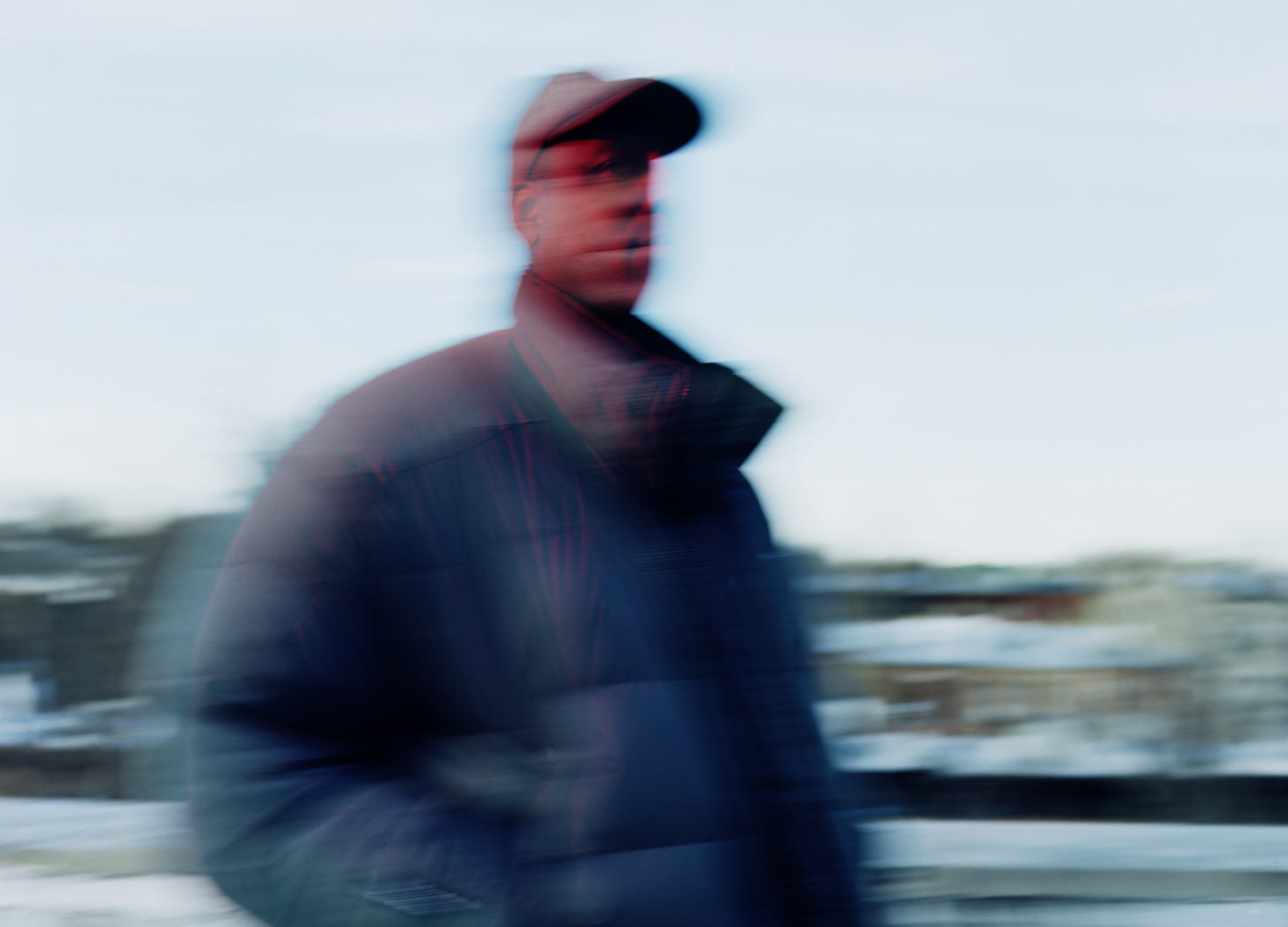
The latest guest recommendation comes from James Bangura, an artist who over the course of the 2020s has quietly become a cornerstone of Washington DC’s oft-underrated dance music scene. Working solo, he’s dropped releases on acclaimed labels like Numbers, !K7, Mister Saturday Night, Incienso and World Building, and he’s also a co-founder of Black Rave Culture, a world-beating, shapeshifting trio that pulls not only from house, techno and the hardcore continuum, but regional club sounds and pretty much anything that bangs the box… [READ MORE ABOUT JAMES BANGURA + CHECK OUT HIS GUEST RECOMMENDATION]
RECOMMENDED RELEASES
The following is a summary of First Floor’s favorite new releases that came out during the past week. Each one has been published with a brief excerpt of the accompanying write-up; to view the full text (and hear the actual music) for an individual release, click the “Listen to the Music + Read the Full Write-Up” link, or you can also just head over to this convenient Buy Music Club list if you prefer to listen to all of the selections in one place.
Cate Kennan – Shadows (kranky)
… The grainy, tape-esque sound of her debut album Shadows is an essential facet of the listening experience, one that matches her fragile, twilight vocals and winsome, subtly spooky melodies. Flickering like an unearthed Super 8 reel, the LP is an addictive, alluring portal that Kennan artfully opens up and pulls you through. [LISTEN TO THE MUSIC + READ THE FULL WRITE-UP]
Frits Wentink – Redline (Clone Royal Oak)
… As the zeitgeist has shifted in this decade, Wentink has continued to put out house records, but his music has gotten more refined, deeper, and maybe even a bit more serious. But not too serious, as Redline, his latest release from Clone Royal Oak, still displays the cheekiness of a committed prankster. [LISTEN TO THE MUSIC + READ THE FULL WRITE-UP]
DJ Plead – Please (Smalltown Supersound)
… Reminiscent of his 2020 full-length Relentless Trills, the record looks beyond the dancefloor, instead offering a window to a more intimate and provocative innerworld. Its emotive strains of Arabesque synths carry traces of history, connecting distant lands from the artist’s origin with a sense of longing for places half-remembered and half-inherited. [LISTEN TO THE MUSIC + READ THE FULL WRITE-UP]
Batu & Donato Dozzy – Exhale (!K7)
… As the title indicates, Exhale is interested in how music breathes, contracting and pulsing like some spore-emitting mushroom in an ’80s post-apocalyptic anime. It begins in relatively sedate territory with “Emergence,” which like the great Voices from the Lake opener “Iyo” seems to assemble itself in midair out of particles of hallucinogenic gas and ancient swamp emissions. [LISTEN TO THE MUSIC + READ THE FULL WRITE-UP]
Andreas Tilliander – Lava (quiet details)
… His new album Lava doesn’t have much to do with this early music, or really anything he’s made before. Rather than having the electronics provide a structure through which sour chords can slosh, he plunges into inky darkness and then allows lonesome sequencers and laser zaps to meander through the murk. [LISTEN TO THE MUSIC + READ THE FULL WRITE-UP]
That brings us to the end of today’s First Floor digest. Thank you so much for reading the newsletter, and remember, you can find all of this week’s recommended releases on this handy Buy Music Club list. (If you like them, please buy them.)
Until next time,
Shawn
First Floor is published and overseen by Shawn Reynaldo, a freelance writer, editor, presenter and project manager. Find him on LinkedIn and Instagram—and make sure to follow First Floor on Instagram as well—or you can just drop Shawn an email to get in touch about projects, collaborations or other potential opportunities.