

First Floor #296 – Just Be Straight with People
Thoughts on Pitchfork's new subscription rollout, revisiting some gems from 2016, plus a round-up of the latest electronic music news and a fresh crop of recommended new releases.
Everybody is talking about Pitchfork (again). Earlier this week, the publication announced—via a letter from Mano Sundaresan, the current head of editorial content—that it was launching paid subscriptions, effective immediately. For the price of five dollars per month, he explained that subscribers are now able to “score albums themselves, comment on our reviews, and be in dialogue with our critics and each other.”
Pushing an optimistic narrative that “music and music criticism are inherently social,” Sundaresan made no mention of a need to boost user engagement or create a stable new revenue source. (During a time when online advertising spends are cratering across the media landscape, the latter omission is particularly galling, as nearly all major press outlets are scrambling for cash and looking for ways to shore up their accounting ledgers.) As Pitchfork tells it, these new subscriber tools are merely a way to foster community and communication, a claim which might be more believable if said tools had been implemented without a paywall. Further undercutting the credibility of the site’s stated intentions is a little nugget that Sundaresan slipped into the sixth paragraph of his letter: moving ahead, non-subscribers will be limited to just four free reviews per month. Regardless of whether or not Pitchfork readers have any interest in leaping into comment sections and (supposedly) deepening their “connection to music and each other,” simply reading the reviews will require them to, as Sundaresan encouraged in his letter, “smash subscribe.”
The response to all of this, at least online, has so far been resoundingly negative, especially (and not surprisingly) on social media. A deep well of anti-Pitchfork sentiment has long lingered within the culture, and once again, it’s bubbled to the surface, fueling criticism from seemingly everyone with an axe to grind. Numerous proclamations of the site’s impending demise have been made, while others have seized the chance to opportunistically rail against the very idea of expertise and declare that reviews—and professional criticism more generally—are increasingly irrelevant within the context of the modern music landscape.
Although those making those claims are rarely doing so with pure intentions—oftentimes they’re motivated by petty grievances and anti-intellectual sentiment—there is a level of truth to what they’re saying. Reviews clearly are less important (and less read) than they were in prior eras, and Pitchfork’s decision to paywall its reviews (while leaving all other content types open to the public) is going to weaken the format’s influence even further. Looking to the future, the clout once associated with a Pitchfork review—for both the artist being reviewed and the journalist writing the piece—is all but certain to shrink, which will make the whole thing a far less enticing proposition. Right now, however, reviews continue to be a core part of Pitchfork’s history and identity, which is why it’s hard to fault the site’s current leadership team for trying to find a way to make them more viable, even if doing so means delivering something that’s more palatable to younger readers who don’t care much about how journalism and independent culture worked 20 years ago.
What’s perhaps most objectionable about Pitchfork’s subscription rollout is the lack of real talk. Rather than treating its audience like adults and saying, “If you like the content we make, we need more revenue to keep it going,” they’ve cooked up a fluffy story about how paywalling their content and monetizing a new comment section is actually going to improve the user experience. To be clear, I’m not against the idea of paywalls. First Floor wouldn’t exist without a paywall, and I actually wish that less journalists and publications would be gun-shy about using them. It should not be radical to say that if you like something, or simply want to engage with it, you have to pay for it. In fact, that idea was completely normal up until the year 2000 or so, when the internet, much of it fueled by investment capital that severely distorted traditional economic models, seeded the idea that all content should be free. Decades later, that idea has stubbornly taken root in the culture at large, and it’s endlessly frustrating to see how adamantly opposed people have become to the prospect of paying five dollars, even for something that they consume (and presumably enjoy) on a regular basis.
Now, would I personally pay five dollars a month to Pitchfork? Probably not, because the site is still owned by a corporate entity (Condé Nast), is still running ads and is almost surely engaging in all sorts of behind-the-scenes brand partnerships that are rarely, if ever, disclosed to the public. (It’s kind of wild that the new subscriptions being offered don’t even include an ad-free version of the site.) If I’m going to spend an additional five bucks a month on music writing, I’d rather direct it towards a more independent operation, one whose editorial isn’t compromised by outside business interests and is actually interested in building a sustainable, user-supported business model.
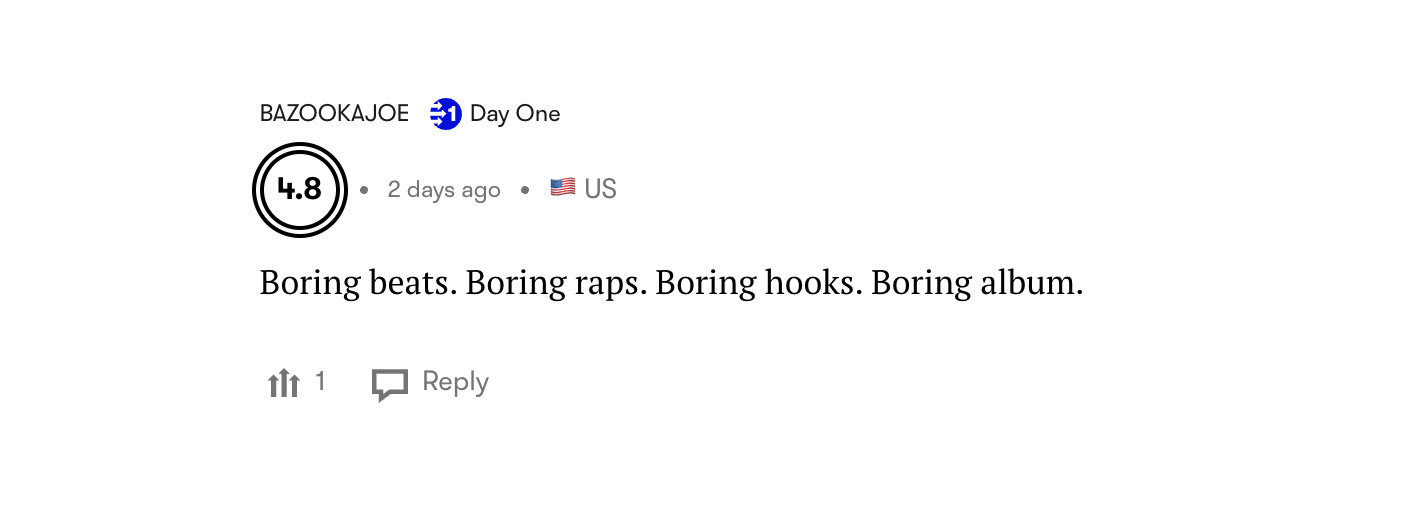
But that’s just me. If there are readers who truly love what Pitchfork is doing, and want to support that work, paying a small monthly subscription fee shouldn’t be a problem for them. And if Pitchfork was a little more honest about why it needed those subscriptions, or if the publication showed some genuine willingness to move toward a more ethical underlying business model, the site would probably have more success getting people—especially older people with more disposable income—to shell out some cash. Why not promise that a certain percentage of subscription revenue will go directly toward paying contributors higher fees? Or promise that once a certain number of subscribers is reached, the site will debut some (previously unaffordable) content type, or simply increase the amount of coverage on offer? There has to be something more enticing than a little “Day One” badge and the chance to mix it up with the genius observations of some guy named “Bazookajoe” in the comment section:
We’ll see where this all goes, but in the meantime, I’ve got my own subscription-supported publication to run. Earlier this week, paying First Floor subscribers got the chance to peek at a list of music from 2016 that I put together in response to the internet’s current obsession with that cursed year. Rather than digging up goofy old photos of myself, I dug through my archives and picked out 16 electronic records from 2016 that A) still sound really good and B) aren’t discussed all that much these days.
If you’re going to take a trip down memory lane, why not make sure that it has a good soundtrack, right?
You can find my 2016 soundtrack below—and yes, the paywall is now down, albeit temporarily—and if you keep going, you’ll find the rest of today’s First Floor digest. News items, new release announcements, suggested reading links… you probably know the drill by now, and there’s also a round-up of all the latest recommended releases that dropped during the past week.
Let’s get started.
IN CASE YOU MISSED IT:
Every week, First Floor publishes a long-form piece that’s initially made available to paid subscribers only. But if you’re not part of the paid tier, now’s your chance to see what you missed! The latest piece is now open to everyone, and it’s an attempt to engage with the internet’s latest fascination (i.e. the year 2016) in a more constructive way. Whether or not you were paying close attention to electronic music back then, there are some real gems in this list.

FIRST FLOOR IS COMING TO MENT
Next month, First Floor has been invited to curate and moderate a panel as part of the conference programming at MENT, a Ljubljana-based festival that will be taking place from February 18 to 21. With the full conference program having been unveiled this week, I’m happy to share the details of that panel. Part of CE/MENT (i.e. the portion of the festival specifically dedicated to electronic music), it’s called “Music and Politics: The Calculus of Speaking Up,” and will include artists ABADIR and Jaymie Silk, booking agent / journalist Yuko Asanuma and journalist Ed Gillett. More details can be found here.
WHAT’S BEEN HAPPENING
A round-up of the most interesting electronic music news from the past week, plus links to interviews, articles and other things I think are worth sharing.
It’s only been a year since Boiler Room was sold to UK festival conglomerate Superstruct, and in the wake of that sale, things have not been going well for the livestreaming platform. Following an announcement last November that a substantial round of staff layoffs would be taking place, news broke this week (via Resident Advisor) that Blaise Bellville, Boiler Room’s oft-criticized founder and CEO, had resigned in December and officially left the company last week. A successor has yet to be named.
The recent decision by Bandcamp to ban music “that is generated wholly or in substantial part by AI” from its platform has been greeted enthusiastically by much of the music ecosystem, at least online, but Ghostly International founder Sam Valenti sounded a thoughtful note of caution in the latest edition of his Herb Sundays newsletter. Applying a healthy (and much needed) dose of nuance to the discussion, he shares deep concerns about where generative AI and the tech industry are headed, but also questions whether the phenomenon can truly (or even should) be halted. He also worries that current anti-AI sentiment is starting to look like the “drum machines have no soul” bumper stickers that were once favored by fans of supposedly “real” and “authentic” music. In effect, he takes issue with the way the entire AI debate is currently unfolding, and advocates for what he calls “aesthetic morality” as a superior way forward.
Speaking of generative AI and the music industry, The Guardian enlisted writer Eamonn Forde to profile Mikey Schulman, the CEO and co-founder of Suno. The piece doesn’t shy away from the many critiques that have been thrown his way, but Schulman conveniently dodges many of the most difficult questions (e.g. whether the company’s AI model was trained on copyrighted material) by claiming that pending litigation prevents him from speaking on those matters. He does, however, claim that what constitutes so-called “AI slop” is subjective, and proudly touts Suno as the Ozempic of the music industry because “everybody is on it and nobody wants to talk about it.”
With journalists of all stripes growing weary of how corporations, investment capital and private equity have hollowed out their industry, many are pointing toward worker-owned media outlets as a potential alternative. Defector, a sports and culture website that recently celebrated its five-year anniversary, is often cited as a shining example of how worker-owned models can actually work, but in an illuminating new article, company co-founder Jasper Wang reflects back on the site’s beginnings and outlines the many challenges its team has faced. More importantly, he points out the unique timing, conditions and funding sources that have allowed Defector to establish itself, and warns that it may not be easy for other aspiring worker-owned outlets to duplicate their success.
OBLIGATORY BOOK MENTION
My first book is out now. It’s called First Floor Vol. 1: Reflections on Electronic Music Culture, and you can order it from my publisher Velocity Press. However, if you’re outside of the UK, I recommend that you either inquire at your favorite local bookshop or try one of the online sales links that have been compiled here.
JUST ANNOUNCED
A round-up of noteworthy new and upcoming releases announced during the past week.
Christina Vantzou and Félicia Atkinson have a new collaborative album on the way. The two friends and experimental musicians recorded the record—which is called Reflections Vol. 3: Water Poems—on the Greek island of Hydra, and it’s due to arrive on April 10 via the RVNG Intl. label. Ahead of that, LP opener “Film Still / The Sea” has already been shared, along with an accompanying video. (And if that’s not enough to tide you over, it’s also worth noting that Atkinson delivered this week’s guest recommendation for First Floor, which was published yesterday.)
Avalon Emerson has spent much of the past two years focused on the dancefloor and working behind the decks, but she’ll soon be returning to her more pop-oriented band project, Avalon Emerson & the Charm, which just yesterday announced a forthcoming new full-length. Entitled Written into Changes, the album was mostly produced by Bullion (two tracks were produced by Rostam Batmanglij), and is said to be about “not just accepting change, but embracing it with a full wingspan.” Dead Oceans will be issuing the LP on March 20, but two songs—the previously released “Eden” and new single “Jupiter and Mars”—are already available here, and a video for the latter has also been published. (Full disclosure: Emerson and I work together on the Buy Music Club platform.)
Having teased listeners with a series of singles for the Greco-Roman imprint during the past year, Lone will soon be releasing an album through the label. Hyperphantasia is something the UK veteran describes as “unhinged, unrestrained, self-indulgent bat-shit pop music from an alternate dimension,” and it’s scheduled to surface on March 27. More details can be found here.
Cover-Up is a new documentary about Pulitzer Prize-winning investigative journalist Seymour Hersh, and experimental composer / synthesist Maya Shenfeld was tapped to do the music for it. The film was released late last year, and Shenfeld’s soundtrack—which is available now—has since been issued via Thrill Jockey.
Following up his acclaimed Sexta dos Crias album from 2023, internet-busting Brazilian artist DJ Ramon Sucesso has offered up a sequel, Sexta dos Crias 2.0. Out now on the Lugar Alto label, it once again spotlights his adventurous approach to the baile funk genre—which, of course, Brazilians themselves just call “funk”—and those curious to know more about Sucesso can also check his recent Tone Glow interview with writer Joshua Minsoo Kim.
Baalti have completed a new album, Threads, which they made in collaboration with fellow South Asian producer Lapgan. The full details of the LP—which is slated to drop on April 3—have not yet been shared, but it was apparently recorded during a psychedelic meet-up in the California desert, and a small taste of the record has been provided in the form of first single “Lime Tikka.” Out now, the song is best experienced via its accompanying music video, a nine-minute, sci-fi-flavored clip that’s more like a short film.
Last year’s Tom’s Tweaks / Let You Know release on Local Action included a couple of UK funky-leaning belters from Bristol mainstay Hodge, and now the London-based imprint has issued a companion record called JIALING & LWS Remixes. True to its title, it contains one rework each from rising talents JIALING and LWS, and both tracks are available now.
Experimental artist and 3XL regular Ben Bondy has taken part in many collaborations over the years, and this week he debuted a new one, vitimin, which also includes Shaun Sutkus of the band Perfect Pussy. The duo’s self-released first offering, i, apparently contains sounds that date back as far as 2013, and it’s available now.
RECOMMENDED RELEASES
The following is a summary of First Floor’s favorite new releases that came out during the past week. Each one has been published with a brief excerpt of the accompanying write-up; to view the full text (and hear the actual music) for an individual release, click the “Listen + Read More” link, or you can also just head over to this convenient Buy Music Club list if you prefer to listen to all of the selections in one place.
Mary Lattimore & Julianna Barwick – Tragic Magic (InFiné)
Much of the record does have a notably baroque quality—at least some of that is due to the fact that Lattimore used a variety of 18th- and 19th-century harps—and while that does at times conjure images of lavish royal salons and gilded aristocratic fineries, Barwick’s woozy synth textures also lend the proceedings a cinematic, almost sci-fi feel. [LISTEN + READ MORE]
DJ Hell – Neoclash (International Deejay Gigolo)
Far from being a victory lap of guitar-fueled adrenaline and neon spandex, the record borrows heavily from old-school Chicago house and acid. [LISTEN + READ MORE]
Mike Shannon – Off World Synthetics (Rekids)
If you like your house wonky and with bite, this stuff will be catnip. [LISTEN + READ MORE]
Fabiano do Nascimento and E Ruscha V – Aquáticos (Music from Memory)
Nascimento’s guitar playing is as lovely as it has ever been and Ruscha’s groovy but lethargic drum programming and sun-kissed synth patches are lush and gorgeous. [LISTEN + READ MORE]
Velv.93 – Maidstone (STROOM)
It’s ambient, yes, but more importantly, it’s deeply patient, as the LP’s 12 tracks unfold with the quiet urgency of a glacier that’s steadily, but almost imperceptibly, advancing across the tundra. [LISTEN + READ MORE]
Slow Dancing Society – The Disappearing Collective Vol. II (Past Inside the Present)
Slow Dancing Society has constructed his own lush soundworld, and others are more than welcome to join him in it, but if they don’t, he’s fine to calmly float along on his own. [LISTEN + READ MORE]
That brings us to the end of today’s First Floor digest. Thank you so much for reading the newsletter, and remember, you can find all of this week’s recommended releases on this handy Buy Music Club list. (If you like them, please buy them.)
Until next time,
Shawn
First Floor is published and overseen by Shawn Reynaldo, a freelance writer, editor, presenter and project manager. Find him on LinkedIn and Instagram—and make sure to follow First Floor on Instagram as well—or you can just drop Shawn an email to get in touch about projects, collaborations or potential work opportunities.