

Betty Hammerschlag is having a bit of a moment. Just last week, The Quietus included “Hot Snow”—a track from the artist’s forthcoming Psycho Summer album—in its round-up of August’s best music. The very same day, The Guardian listed “Damn Bird”—another Psycho Summer selection—in its weekly Add to Playlist feature, which was actually the second time Hammerschlag had landed in the UK paper; the first was last October, when “Deep”—a song from 2025’s fake girl—was highlighted in a different edition of the very same column. Hammerschlag’s music has also been a favorite of NTS Radio, logging more than 60 spins across numerous programs, including broadcasts hosted by HTRK, Nosedrip, Julianna Barwick & Mary Lattimore, Mark Leckey. (Back in 2024, the Drowned by Locals label—which is now poised to release Psycho Summer later this month—even had Hammerschlag put together a guest mix for its bimonthly show on the station.)
The accolades don’t stop there. A variety of blogs and newsletters—including First Floor—have loudly sung Hammerschlag’s praises, and even the notoriously picky curators at Boomkat have proven susceptible to the artist’s charms. The online retailer touted fake girl as “a beautiful set of abstracted folk diversions,” and more recently gave Psycho Summer its own glowing write-up, saying the record sits “somewhere between lo-fi folk artists like Diane Cluck, fusion-minded experimentalists CocoRosie and laptop-brained contemporary innovators such as ML Buch.” [Update: Shortly after this article went live, Boomkat deleted several Hammerschlag releases, including fake girl, and though the listing for Psycho Summer is still live, the album’s accompanying review has been removed. As such, the Boomkat links that were previously listed here have been removed.]
The most frequent comparison, however, is Grouper, and Hammerschlag has repeatedly been described as a Gen Z version of the famed singer-songwriter. That age-related distinction is crucial, and not accidental, as visual representations of Hammerschlag are deeply Zoomer-coded. Scanning through release artwork and the artist’s carefully curated Instagram account, it quickly becomes clear that a number of different women are being depicted; yet those women are uniformly young, and often exude a sort of beautiful ennui, whether they’re marinating in the haze of a messy bedroom or dejectedly smoking in Mother Nature. Regardless of whether those images are “real” or authentic, they’re loaded with femme signifiers. Add in the whimsical captions—which are heavy on purple heart and butterfly emojis and light on capitalization—and the fact that Hammerschlag has always used she/her pronouns, and one naturally gets the impression that the artist is a stylish (and possibly quite introverted) young woman, or at the very least is someone who isn’t a straight cis man.
The labels who’ve released Hammerschlag’s music—including Drowned by Locals, blush, SPA, Collerette and Transatlantic—have all amplified that narrative, as has UK publicity firm 9PR, which has been leading the current campaign around the Psycho Summer album. And though the press has happily latched on to the mystery around Hammerschlag’s identity—one of the aforementioned Guardian pieces described the artist as an “enigmatic songwriter,” while The Quietus opted for the phrase “inscrutable internet-based enigma”—there’s been seemingly no attempt to look much deeper.
That’s not unusual. Most contemporary music publications are desperate to appear “artist friendly”—especially when securing artists for features and brand partnerships is a key component of their editorial strategy and business model—and in a time when preferred pronouns and fluid gender identities have become largely normalized (at least within the cultural sector), journalists and other industry professionals are generally loath to question any aspect of an artist’s stated identity. That goes double when it comes to younger artists, particularly those who seem to primarily exist and operate online, as a certain level of mystery has been baked into that corner of the music world.
Betty Hammerschlag resides squarely in that corner, and while the artist has been presented as a reclusive, lo-fi songwriter, that persona is an elaborate fiction, one that continues to be perpetrated by its creator, Tilman Hornig.
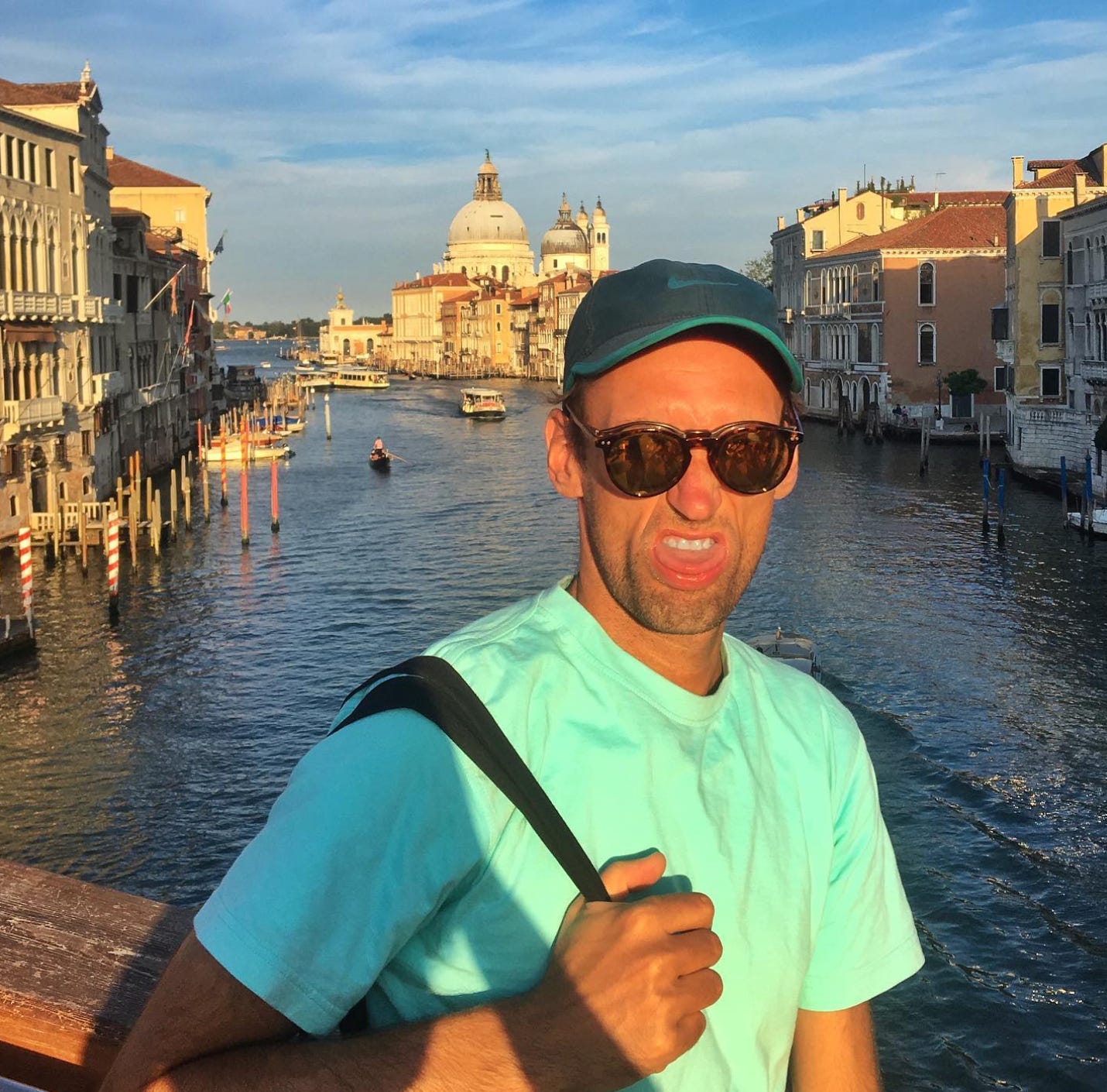
Hornig, of course, hasn’t publicly copped to any of this. A German mixed-media artist who also runs the New Scenario platform alongside creative partner and frequent collaborator Paul Barsch—the two also have a band together called DRONE OPERATØR—he’s at least 45 years old (different sites list his birth year as 1979 or 1980), and has long seen himself as something of a disruptive force in the art realm. In a 2020 interview with AQNB, he and Barsch stated, “The art world has never felt more boring,” and that same article highlighted the duo’s 2016 breakthrough, Body Holes, which was part of the DIS-commissioned Berlin Biennale and involved “the miniature work of 46 artists and collectives [being] inserted into one of seven human orifices, photographed and then displayed online.” Some of their other projects include Immer Müde und Scheiss Wetter in New York, for which the pair plastered sleepy photos of each other onto custom-made umbrellas, and Stalking Macaulay Culkin, a photo series that utilized paper cutouts of various paparazzi shots of the former child star.
When exactly Hornig began masquerading at Betty Hammerschlag isn’t clear, but it dates back to at least 2021, when the song “Siblings”—credited to a Betty Hammershlag—appeared on From Dawn Till Dusk, a compilation of rap- and trap-themed tracks from French imprint Dawn Records. In an interview with First Floor, label founder Hajj admitted that he knew all along that Hornig was behind the music. Already a fan of the German artist’s work under his own name, Hajj had reached out to Hornig directly, asking if he’d like to contribute a track. It wasn’t until “Siblings” landed in his inbox that he encountered the Betty Hammershlag moniker, and when he asked for an explanation, the only response he received was “new year new name lol.”
On subsequent releases, Hammershlag became Hammerschlag, but Hornig’s relationship with the labels issuing that material is difficult to parse, primarily because the people heading up these outposts have largely refused to speak on the record. SPA Recordings co-founder Philip Jondo, for instance, responded to First Floor’s inquiries by saying, “Regarding Betty I would suggest you reach out to the artist directly as we are not representatives.” That dodge, however, doesn’t obscure the fact that the Cologne label was home to this year’s TYPE SHIT, which was playfully presented on Bandcamp with the following, very Gen Z description:
a coLLecTion of unmastered BettY audio material♬: ',,
looops, collages & edits created in the conteXt of guest mixes,
semi random DAW misc + other fuN ݁⊹..˚✧⋆.˚ *
Back in 2023, SPA also issued a “reboot” of Hammerschlag’s ISCP EP, a release that was “originally recorded at the International Studio & Curatorial Program, Brooklyn, in 2018.” When contacted by First Floor, an ISCP representative confirmed that while the EP’s artwork does in fact depict a room in their facility, the organization has no record of working with a Betty Hammerschlag. Hornig, on the other hand, is a previous ISCP resident and returned in 2018 on a fellowship from the Kulturstiftung des Freistaates Sachsen.
French label Collerette released Hammerschlag’s Forever Young last year, and though founder Yannis Arnouil initially responded positively to First Floor’s request for an interview, saying he’d be “happy to help,” he changed his tune after speaking to the artist, communicating that he “had to consult with Betty and the artist’s decision is to keep any info private.” When pressed, Arnouil declined to state exactly how much he knew about Hammerschlag’s identity, but other people who’ve done business with the artist proved more willing to talk—and several of them made clear that not everyone is being kept in the loop about the project’s true nature.
Chicago-based artist Baby, whose heavily Auto-Tuned vocals appear on TYPE SHIT, first linked up with Hammerschlag online, developing a “casual internet friendship” based on “how [they] rock with each other’s music.” The two have never met in person or even spoken on a video call, but Baby—who is still under the impression that Hammerschlag is a young woman—told First Floor that he was thrilled with the experience, stating. “It was awesome to see TYPE SHIT. I was like damn you just cook like crazy.”
tibslc, an ambient / experimental artist from Leipzig who earlier this year became aware that Hammerschlag is actually the work of Hornig, has been left with a far less positive impression. While the two have never worked together, they have interacted online (mostly in German), and at one point tibslc invited Hammerschlag to perform at a show she was organizing in the summer of 2025. That invitation was declined with the following message, which has been translated into English:
oh hi tibslc, thank you so much for the request!!!! that sounds really great. currently and in August, however, I hardly have any time, I have to study for several exams and hardly have the energy for music and live shows ❤️
Even before that exchange, tibslc had taken notice of Hammerschlag’s youthful, femme-coded online presence, and believed it to be genuine, observing that “it seemed obvious the artworks were some kind of collage of some internet picture, the way many people do it on SoundCloud and elsewhere, but the account seemed to signal non-cis male from all aspects.” Receiving a message in which Hammerschlag cited the need to “study for several exams” only strengthened that impression. As a non-cis male herself, tibslc felt safe conversing with Hammerschlag and inviting the artist to perform, but that feeling was shattered when she later discovered the truth about who was behind the project. “When I eventually learned about the fact that Tilman Hornig, a 47(?) year old guy, was running it the whole time, it was really quite a shock, like one of those moments when your reality is shaking to the core because someone tricked you,” she says. “I was emotionally unwell and affected by it a lot. I felt like I was played, especially because of the private chat.”
Note: Shortly after this piece was published, blush label founder Tim Dalzell, who declined to speak to First Floor on the record during the course of my initial reporting, published a couple of Instagram stories regarding Betty Hammerschlag. They read in part:
Given some of the wording in Shawn’s article I just want to clarify that I had no idea who was behind the project when I released it.
The whole time we worked together he messaged me in the style and dialect of a young girl, creating elaborate lies to cover his tracks.. at one point he asked for royalties to be paid earlier so he could buy paints for art school.
I was under the impression the artist wanted privacy and respected that. When I found out the deal (earlier this year) - I expressed my concerns to him about how he was running the project. I didn’t like how he responded and so I decided to stop selling the music.
Don’t wanna make a scene about all this, I’m already exhausted by how much energy it’s taken up, but just want to highlight that a lot of us involved were scammed as well.
When Shawn says the labels that released the music ‘amplified the narrative’ that the artist was creating - this may be the case, but certainly for me, it was without any consent for being involved in this madness
For the record I think using a fem alias/disguise to give clout to your music is pathetic. Would never have been involved in it if I knew the deal.
Hornig must know that he’s actively tricking people, yet he’s continued to expand the scope of his play-acting, particularly when it comes to live shows. Hammerschlag has been booked for a smattering of performances over the past few years, and rather than coming clean, Hornig has instead gone to elaborate lengths to further the illusion. In March of this year, Belgian event series Lise teamed up with the STROOM label, putting on a night at Brussels venue Les Ateliers Claus that included Felicity J Lord, TLF Trio and Betty Hammerschlag. During the run-up to the gig, Lise founder Tobin Verdonck communicated extensively with “Betty” via email, and as part of the deal, wound up booking a train ticket from Frankfurt, Germany. The name on that ticket was not Betty Hammerschlag or Tilman Hornig, but one Lucia K., who was supposedly born in 2004. [Update, September 5, 13:05 CET: Lucia’s full name is known to First Floor, but after receiving a request—one acknowledging that she “participated in the project willingly”—her identity has now been partially anonymized.] At the time, Verdonck didn’t think much of it, and the idea that he was negotiating with a plucky young artist was further amplified by Hammerschlag’s decidedly cutesy tech rider:
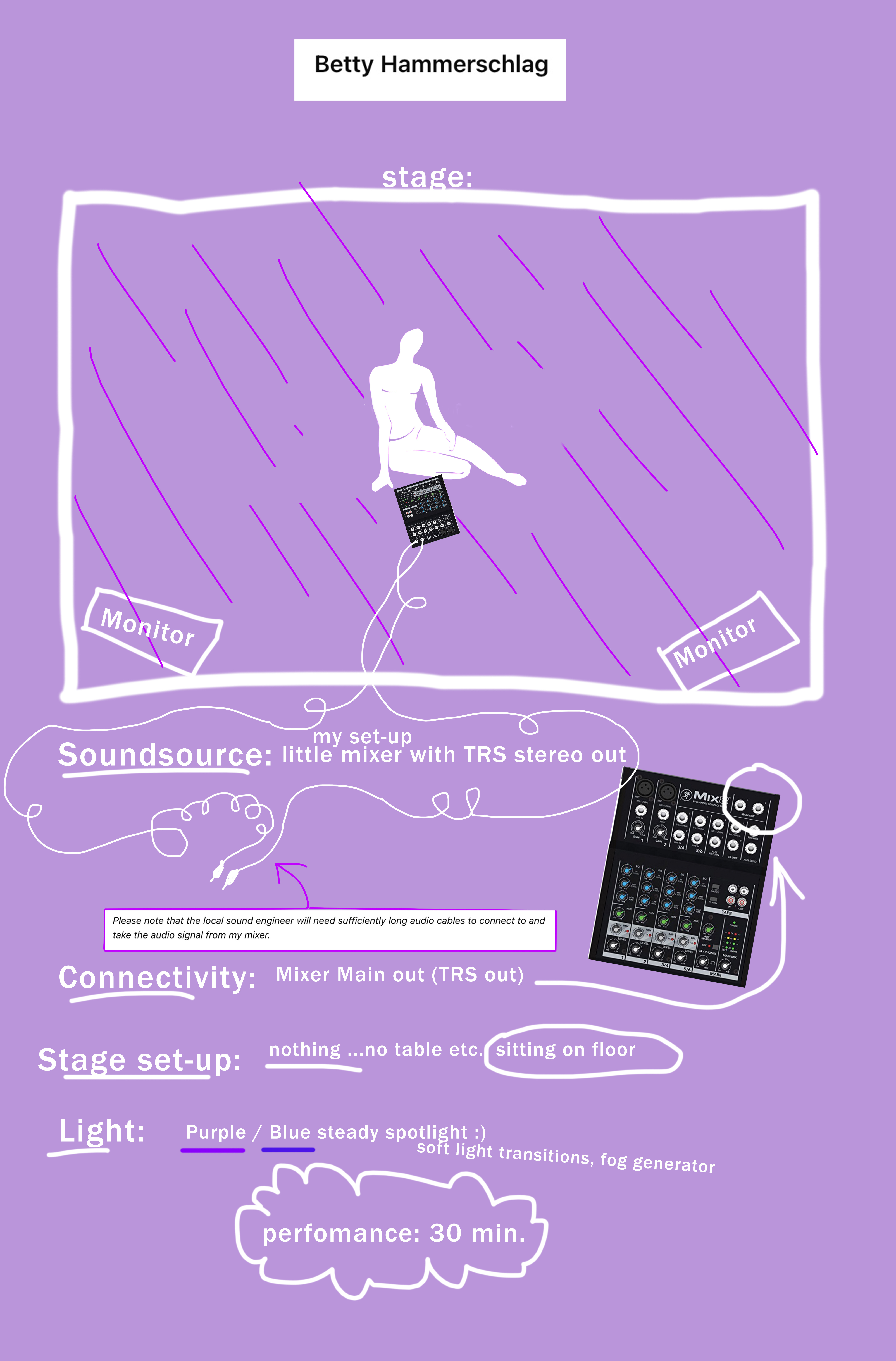
When the day of the concert rolled around, someone claiming to be Betty Hammerschlag did turn up, but as STROOM founder Ziggy Devriendt (a.k.a. Nosedrip) confirmed to First Floor, “I said three sentences to her and [it] was quite clear it was not the Betty from online.” Verdonck had a similarly odd experience, noting that a musician friend attempted to ask “Betty” about her experience working with a particular label, and realized that she had no idea whatsoever what he was referring to.
The show itself was also quite bizarre, as the artist sat on the floor with little more than a portable walkman and a selection of tapes, which she periodically swapped in and out of the player. (As far as Verdonck could tell, the music being played sounded like Betty Hammerschlag material, though he wasn’t completely sure.) Otherwise, she spent the entire 30 minutes silently smoking, save for a brief moment at the beginning of the performance when she sternly announced that she wanted no cis white males in the front row.
A similar scene recently unfolded at London’s Cafe OTO, where Hammerschlag was booked as part of a July 30 event curated by the Jolly Discs label. According to one artist on the bill, who asked to remain unnamed, a young woman claiming to be Betty Hammerschlag arrived at the venue, accompanied by a man who didn’t introduce himself, but nonetheless seemed to be “very involved” in making sure her show ran smoothly. Jolly Discs founder Guy Gormley organized and advanced the show, and told First Floor that “in correspondence it’s as if you are speaking directly with Betty.” He never learned the actual names of the performer or her male companion—though he believes she responded to “Betty”—and when he asked where they’d come from, she deflected, saying only that they’d caught the Eurostar in Belgium.
Gormley didn’t hate the show, noting that it was “surprising that someone sitting still playing tapes could be engaging,” and added that the performer at one point ate a pear, “which seemed like she was making a conscious gesture.” In the days before the concert, he’d actually heard rumors that Betty Hammerschlag was in truth the work of a man, but he found it too awkward to come right out and ask the performer about it at Cafe OTO. Even now, he seems not completely sure what to believe, as both the concert and his in-person interactions with “Betty” left him thinking that “she really felt like she could be the author of the online content and music.”
Hornig, it seems, has crafted a rather convincing ruse, working hard to cover his tracks as he goes. When requesting payment for the shows at Les Ateliers Claus and Cafe OTO, he sent both Verdonck and Gormley the same Paypal address, which linked to an account with the name Lila Schmetterln—which is just a few letters away from the German term for “purple butterfly,” one of Hammerschlag’s go-to emojis. (A message sent by First Floor to the same Paypal account received no response.) The subterfuge also extends across Bandcamp and various streaming platforms, where the name Betty Hammerschlag always appears in the small-print songwriting and production credits. His track record, however, is just shy of perfect: on Apple Music, the 2024 single “Cream” lists Tilman Hornig as the lone songwriter:

When it comes to the visual component of Hammerschlag, Hornig has historically been much more cavalier. The blonde woman in the above screenshot, for instance, looks a whole lot like a Pinterest user named Shyatesa, who has the exact same picture on her profile. A different woman—one with a gothier look and two middle fingers in the air—graced the cover of 2023’s Me & You, and she too appears to be a Pinterest find. Sourcing pictures of young women from the internet seems to have been Hornig’s m.o., and when it came to release artwork, he appears to have applied a similar technique, seeking out feminine-coded images that these women would presumably like. The cover of 2023’s Unfinished Love Songs, for instance, utilizes a photo of a heart-shaped chain and lock that’s been circulating online for quite some time—among other places, I found it in a 2021 Facebook post—and the cover of last year’s Forever Young is an altered version of an image of young people doing drugs in a bedroom that’s all over TikTok, Pinterest, SoundCloud and pretty much every other online platform.
In recent months, Hornig does seem to have tightened up his visual approach, particularly in relation to upcoming Psycho Summer album, which is being promoted with a new young woman as the project’s primary avatar:

The identity of this woman is unknown, as is her relationship to Hornig, but according to Jolly Discs’ Gormley, this is the same person who showed up to perform at Cafe OTO. (His claim is bolstered by live footage captured at the event.)
Considering the increased press and industry attention that Betty Hammerschlag has attracted over the past year, it’s feasible that Hornig is now attempting to formalize the project and expand its profile. At the same time, he also seems determined to maintain the fiction he’s created. According to press mailouts from 9PR and the Drowned by Locals label—who are jointly waging a promotional campaign in advance of the Psycho Summer album—Betty Hammerschlag is currently available for interviews, but only via email. First Floor made repeated requests to speak with the artist in a format that involved an actual conversation (e.g. phone call, video meeting, etc.)—and in those requests, the Betty Hammerschlag email account was on cc—but they were all either rejected or ignored. Drowned by Locals did at one point propose a “postcard interview,” where Hammerschlag would respond to written questions with “handwritten responses on a series of physical postcards.” Uninterested in playing along with Hornig’s ongoing game of make believe, I declined the offer.
(In the lead-up to this article being published, First Floor did also individually reach out to both Drowned by Locals and 9PR for comment; the former failed to respond, while the latter indicated that all further inquiries about Betty Hammerschlag should be directed to the label. A separate request sent directly to the Betty Hammerschlag email account went unanswered, as did messages sent to Hornig via email and Instagram.)
[Update: The day after this article was published, Duncan Clark, 9PR’s Owner and Head of Press, submitted the following statement to First Floor: “9PR were not made aware that Betty was actually Tilman. We were not wittingly complicit.”]
With both Hornig and “Betty” either staying silent or refusing to have a live conversation, and so many of those who’ve been involved with Betty Hammerschlag releases also declining to share what they know, multiple questions remain about the nature of the project and what’s motivating it. First Floor, however, has developed several theories about going on, and I have dedicated the rest of this article to laying them out and sharing my own opinions about what I’ve observed.
Given the irreverent—some might say shit-stirring—nature of the art Hornig has made under his own name over the years, one might assume that he sees the Betty Hammerschlag project as some sort of critical endeavor, holding up a mirror to the shallowness and absurdity of contemporary youth culture and the experimental music realm. Those things are absolutely ripe for all kinds of critique, but rather than making that critique under his own name, he’s chosen to hide behind a character—one he’s intentionally designed to deceive people.
That deception, by the way, most likely involves the use of AI. First Floor ran the promotional text for Psycho Summer through multiple AI detectors, and while those tools are admittedly unreliable, almost all of them came back with a “high probability of AI” finding. As for the actual music, it’s impossible to know the exact role of AI, but considering that Hornig has previously produced a substantial volume of music through his involvement in DRONE OPERATØR and other projects, it seems unlikely that the Hammerschlag material is completely AI-generated. The biggest question mark revolves around the vocals; they convincingly sound like a young woman, but unless he’s enlisted an unnamed party to be the voice of Betty Hammerschlag, it’s not unreasonable to think that some sort of AI tool is involved.
A fellow journalist, who asked to remain unnamed, informed First Floor that when they recently questioned Drowned by Locals about the involvement of AI in the Betty Hammerschlag project, the label went silent and neglected to respond. And earlier this week, when several AI-related accusations surfaced in the comments section of an Instagram post touting Hammerschlag’s recent Guardian coverage, the label became even more protective, deleting those comments and blocking the users who’d made them.
Even if the AI issue is set aside entirely—and given the current cultural climate, that’s a very big ask—the far more troubling aspect of the Betty Hammerschlag project is that the whole thing revolves around a well connected, middle-aged German man cosplaying as some sort of melancholy Zoomer e-girl. It’s creepy, especially when so many of the people that Hornig is interacting with—including people that he has directly sought out online—are unwitting participants in an art project they didn’t ask to join.
Though he’s admittedly left several clues about that project’s true nature hiding in plain sight (e.g. titling an album fake girl, using the phrase “emo fiction” on the bio line of the Betty Hammerschlag Bandcamp page), Hornig’s actions still raise huge questions of consent—or, more specifically, the seeming lack thereof—as he appears to be catfishing fans, promoters, fellow artists and possibly even some of the labels he’s working with. There’s also the issue of the photos he’s using to create Betty Hammerschlag’s image. Who took them? Who are the women that they depict? Is anyone being compensated? It’s one thing for a twentysomething bedroom artist to pilfer images online and use them without crediting anyone, but when the person doing it is an established artist who’s approaching 50, the ethics of the act look a whole lot uglier.
Side projects, mystery and identity plays have long been a part of art and music culture, even in recent years. When Dean Blunt won the Philip Hall Radar Award at the 2015 NME Awards, he famously sent a random lookalike to give a speech and accept the statue in his place. Two Shell have made the idea of subverting identity central to nearly everything they do, and when they were booked to play on Boiler Room at the Primavera Sound festival in 2022, they hired a couple of guys to put on masks and pantomime an on-camera DJ set while a prerecorded mix played.
While the artistic value of these kinds of antics is very much up for debate, the people involved usually aren’t punching down, or cynically appropriating the identity of marginalized groups to accomplish their creative goals. Can Hornig say the same? Betty Hammerschlag isn’t satire; it’s an exercise in smug self-satisfaction, one in which the main targets appear to be A) young and / or queer artists and B) anyone who takes what those artists do seriously. It’s often said that imitation is the highest form of flattery, but in the context of the Betty Hammerschlag project, it feels more like a dismissive insult, one which effectively broadcasts the message, “Look how easy it is for me to copy this young femme aesthetic and fool everyone into thinking it’s authentic.” What Hornig is doing smacks of the edgelord behavior that ran through the culture during the ’80s and ’90s. Back then, this routine might have seemed cool and provocative, but it now reads like the same sort of lazy anti-wokeism that far too many aging straight white men have made their calling card.
On some level, it feels like Hornig probably wants to be caught, and might even derive some kind of perverse pleasure from the fact that a journalist would spend this much time and effort dissecting his work. Guys like this often long to be told how smart they are, and once the truth about Betty Hammerschlag is out there, Hornig can also rest assured that an entire cadre of similarly aggrieved dudes will have his back. (Even now, by maintaining the code of silence around the project and Hornig’s identity, the people running the various labels that he’s worked with have already demonstrated where their loyalties reside. As much as the independent music realm is often characterized as an overzealous bastion of progressivism, the truth is that those who stay quiet about ethically thorny issues are far more likely to be rewarded, particularly in industry circles.)
In the course of researching this article, First Floor found that several Hammerschlag collaborators were already justifying the project and excusing the actions of its creator, even when they refused to disclose who that creator actually is. Collerette label founder Yannis Arnouil never mentioned the name Tilman Hornig, but he was still adamant in saying that “it was never some kind of secret that the Betty Hammerschlag project is a fictional project. Betty herself points to that. There are hints all over the internet, and if you take the time to listen to the music, it all makes sense.”
Another former Hammerschlag collaborator that First Floor spoke with—and who tellingly asked that his name be withheld—was similarly disturbed that anyone would dare to question Hornig’s intentions, stating:
This is an artist, who is creating art. Artists perform. This is a performance. It is shocking to me that anyone invested in art and expression would draw the line here… I suspect this would be seen for the non-issue it is if the artist explicitly identified as trans or otherwise non-binary.
Hornig, for the record, has given no public indication of being trans or non-binary, though the unprompted raising of that issue does say a lot about the current state of male grievance. (And even if the artist was closeted, and Betty Hammerschlag represented some sort of exploration of his sexual orientation and / or gender identity, that wouldn’t explain the age-related cosplay, or justify the repeated and ongoing deception of both his peers and the listening public.) Nevertheless, this former Hornig collaborator then continued:
I struggle to believe that any “outrage” isn’t just poorly suppressed bloodlust. [Hornig’s] music career is already likely to be significantly hampered, if not outright snuffed, as a result of this. And that’s exactly what anyone pretending to moralize about cases like these gets off on. Whole thing reeks of Woke 1.0 in a way I thought we’d moved past culturally.
“He’s an artist.” “This is cancel culture.” “You don’t get it.” “You’re being too sensitive.” Lines like these are sure be trotted out in defense of Hornig, and may very well leave him feeling righteous about what he’s done. The fact that Betty Hammerschlag has already received far more acclaim than any of his other musical endeavors can easily be spun as both a proof of concept and an indictment of the creative industries, with the takeaway message that the musical sphere is too stupid, too beholden to social media discourse and too cowed by political correctness to recognize what good art really is. If that’s Hornig’s take, he’s not necessarily wrong, but the way he’s chosen to make the argument—tricking people while purposely taking up space and opportunities that might otherwise have gone to artists that are actually young, female and / or queer—smacks of the worst kind of arrogance. Hornig unquestionably has the right to conduct himself in this way, but that doesn’t negate the fact that he’s acting like an entitled asshole, and the more he doubles down on what ultimately looks like a mean-spirited cry for attention, the more pathetic he becomes.
First Floor is published and overseen by Shawn Reynaldo, a freelance writer, editor, presenter and project manager. Find him on LinkedIn and Instagram—and make sure to follow First Floor on Instagram as well—or you can just drop Shawn an email to get in touch about projects, collaborations or other potential opportunities.